


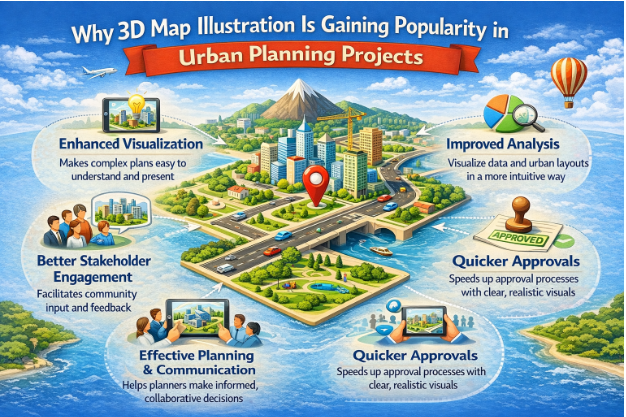
The concept of urban planning has transformed greatly because cities have become crowded and intricate in terms of infrastructure. The conventional 2D drawings and lurid maps are sometimes not good enough to explain spatial relationships, elevation, and the impact of development.
Consequently, 3D map representation is already becoming a more popular technique in urban planning projects, and it provides planners, architects, and decision-makers with a better and more immersive approach to visualizing cities.
With the merging of the correct geographic information and the visual depth, the 3D map illustrations are changing the way in which the urban settings are planned, communicated, and developed.
Clear Visualization of Complex Urban Environments
The urban fabric of contemporary cities is made up of overlaying infrastructure, which comprises roads, utilities, buildings, green areas, and transport systems. Flat maps may not be very useful in communicating the interactions between these elements, whereas 3D map illustration displays the layout of urban areas with depth and perspective, and thus, it is easy to perceive the spatial relationships immediately.
Planners can visualize:
- Constructing heights and densities.
- Highway system and crossroads.
- Topography/ elevation and slopes.
- Nearness between buildings and the areas.
This transparency assists in the minimization of misinterpretation and makes the design decisions more effective in the initial stages of the planning process.
Better Communication with Stakeholders and Communities
Planning urban areas entails the cooperation of the government, developers, architects, engineers, and the citizens. Non-experts may not be able to interpret technical drawings, and this may cause resistance and misunderstanding.
The use of 3D map illustrations gives people a common language that no one can fail to understand. These images straightforwardly convey the plans when developed by the leading 3D rendering firm, and the stakeholders would be able to visualize intended changes and see how developments will impact the environment around them.
This openness enhances trust, increases the rates of approvals, and fosters effective feedback by communities.
Better Evaluation of Environmental and Spatial Impact
The assessment of the environmental impact of urban development is a very important element of planning, which, through 3D map illustration, enables planners to determine the nature of the project’s interaction with the natural features like terrain, waterways, vegetation, and access to sunrays.
Using 3D maps, planners can:
- Shadow pattern and building orientation analysis.
- Know about draining and flood-plagued areas.
- Determine possible environmental limitations.
- Imagine green space integration.
Such lessons assist cities in developing more sustainable and resilient city environments.
Improved Scenario Planning and Decision-Making
Urban planning usually entails testing various development options prior to settling on a plan. The ability to have a comparison among options presented as a 3D map would be an easy way to visualize the differences in size, design, and influence.
The decision-makers have a chance to be fast to assess:
- Accessibility and traffic movement.
- Population density changes
- Infrastructure capacity
- Aesthetic compatibility with the existing buildings.
Such visualization helps in making informed, data-driven decisions that could be in line with long-term urban objectives.
Quickened Project Approvals and Planning Errors
Delays and design mistakes may be expensive. These risks are usually caused by misinterpretation during early phases, and it will result in revisions, high costs, and long schedules; 3D map illustration will help eliminate such risks because it gives precise and detailed drawings of planned developments.
Urban plans can also be clearly visualized, which reduces the number of changes that need to be expensive in the future. The collaboration with the best 3D rendering company guarantees the accuracy, consistency, and high visual quality of the project during the whole process of the project lifecycle.
Innovation in Smart City and Digital Twin
With the adoption of smart technologies by cities, there is an increasing need to have digital twins and data-driven planning, which is where 3D map illustration is important, to provide real-time data in digital representations of urban areas.
These 3D models support:
- Infrastructure monitoring
- Traffic management
- Emergency planning
- Utility optimization
As the graphical base of smart city platforms, 3D map illustrations can enable cities to be smarter and more efficient, as well as reactive to challenges.
Greater Community Involvement and Participation
Active involvement of people is one of the principles of effective city planning. Nevertheless, there is usually reluctance to engage in matters when the plans are not easy to comprehend. 3D map illustrations can make planning proposals easier, which would motivate the citizens to participate in the discussions sincerely.
The interactive 3D images would enable the citizens to see the neighborhoods and see the proposed changes and how the developments will affect their day-to-day lives. This creates feedback that is more informed and robust community support.
Multifunctionality at Planning Stages and Places
The other factor that has led to the increased use of 3D map illustration is the ability to be versatile. These images may be applied in various phases of urban planning, such as conceptualization or the ultimate presentation.
They can be readily flexible to:
- Arranging reports and presentations.
- Web and mobile platforms
- Public consultations
- Shareholder and stakeholder conferences.
The best 3D rendering company should be reliable, so that its maps are always accurate, scalable, and visually consistent across all applications.
Conclusion
With cities constantly growing and urban issues becoming more complicated, planners require technologies that will deliver a clear, precise, and interactive image. 3D map illustration is becoming a popular tool in urban planning projects due to its power to visualize, communicate, and make smarter decisions.
Urban planners can provide better, more efficient, and people-friendly cities with the help of the most qualified 3D rendering firm, converting the complex data into practical and transparent implications of the future.