


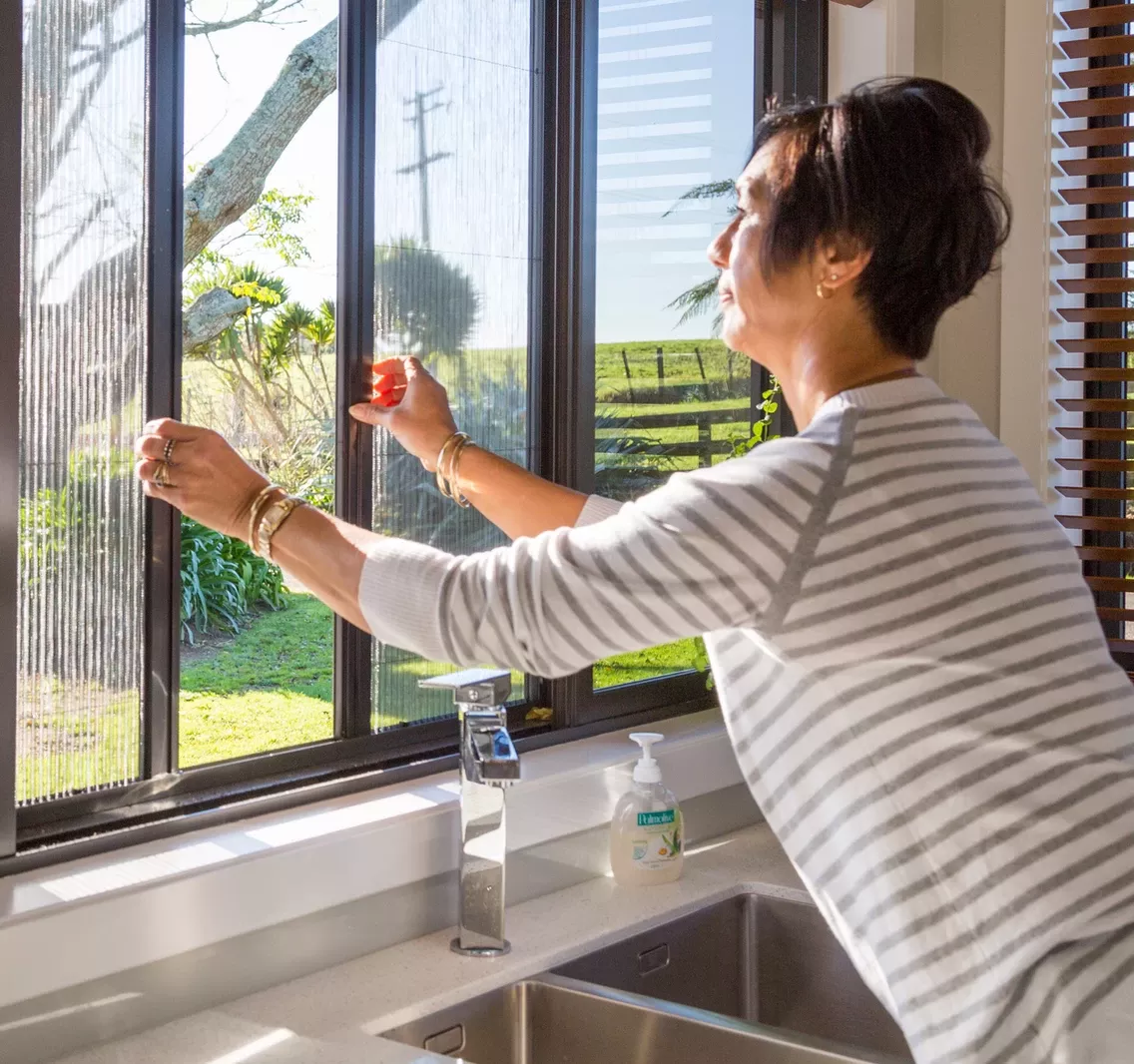
Doorways are the hardest openings to screen. A window can take a fixed panel and be done with it, but a door is used constantly, has to look presentable, and cannot simply be blocked. That is the problem retractable systems were designed around a mesh panel that pulls across when you want it and disappears into a slim housing when you do not. Understanding how they work, where they suit, and what separates a good unit from a frustrating one makes the choice much simpler.
How the Mechanism Works
The mesh is wound on a spring-loaded roller housed in a narrow cassette fitted to one side of the opening. Pulling the leading edge draws the mesh across, guided by tracks at the head and threshold, until it meets a receiving channel on the opposite jamb. Magnetic strips along that edge hold it closed. Releasing a catch lets the spring retract the panel smoothly back into the cassette. Better units include a controlled retraction mechanism that slows the return, preventing the snap-back that damages mesh.
Where They Work Best
The strongest applications are openings used regularly by people. Main entrance doors, balcony and patio doors, sliding glass doors and service yard access all benefit, because a fixed screen would obstruct passage while an unscreened door is the largest gap in the home’s perimeter. They also suit wide openings where a hinged screen would be unwieldy, and situations where the screen must be invisible when not needed. Installing a retractable mosquito screen at a balcony door typically means the door can stay open through the evening without the room filling with insects.
Configurations Available
Single-panel units draw from one side and suit openings up to roughly two metres. Double-panel systems draw from both jambs and meet in the middle, which handles wider openings without excessive spring tension. Horizontal designs are standard for doors; vertical variants pull down from a head-mounted cassette and suit some window and servery applications. Choosing between them depends on the opening width, which side has space for a cassette, and whether anything obstructs the track line at the threshold.
Track Design and Threshold Choices
The bottom track is the detail that determines daily satisfaction. A raised track guides the mesh reliably but creates a small trip edge and collects dirt. A flush or recessed track avoids that but requires either a rebate in the floor or a very low profile guide, and needs sweeping more often to run smoothly. Some designs use a bristled guide instead of a channel, eliminating the trip hazard at the cost of less positive tracking. Where the threshold is used with prams or a wheelchair, this choice matters.
Mesh Specification
The panel material follows the same logic as any screening. Fibreglass is economical and flexible, and its ability to fold without creasing suits a rolling mechanism well. Polyester with a heavier weave resists tearing better, which matters at a doorway where the mesh gets brushed against constantly. Weave density trades airflow against how small an insect it stops a mid-range density excludes mosquitoes and flies without noticeably reducing breeze. Where pets are in the household, a stronger specification is necessary, since a cat or dog pressing against a lightweight panel will damage it quickly.
Households With Pets
Doorways deserve particular attention when there are animals in the home, because they are the opening most likely to be left ajar. A screen that stops insects but yields to a cat leaning on it provides no real barrier. Pet-rated material of the kind used for cat mesh for windows is available in retractable formats and is worth specifying wherever an animal has access. Cats also learn to open unlatched screens, so magnetic closure strength is a genuine consideration rather than a detail.
Installation Requirements
Fitting needs a straight, plumb opening with enough width on one jamb to mount the cassette without fouling the door itself. The head track must be level, since any deviation causes the mesh to run unevenly and jam. Existing architraves sometimes need trimming or packing out. Most units can be surface-mounted with minimal disruption, and finishes are available to match common frame colours. Measurement matters more than with fixed screens, because the mechanism relies on consistent geometry across the whole opening.
Living With One
Daily use is straightforward but a few habits extend the life of the unit considerably. Draw and release the panel by the handle rather than pushing on the mesh, and guide it back rather than letting it snap. Keep the bottom track clear of grit, which is the most common cause of jamming. Clean the mesh with a soft brush rather than pressure washing. Where children use the door frequently, showing them how to operate the handle prevents most damage.
Combining With Window Screening
A door screen is most effective as part of a complete perimeter rather than on its own, since insects will use whichever opening remains uncovered. Pairing retractable door units with fixed or magnetic insect netting for windows throughout the home produces a consistent result, and specifying both together usually costs less than doing them separately. It also keeps materials and colours consistent, which matters for how the installation looks.
Choosing a Supplier
Ask about mesh specification, the retraction mechanism, threshold track options and the warranty on the spring and cassette, since those are the components that eventually wear. Confirm that replacement mesh can be fitted to the existing housing rather than requiring a whole new unit. A measured survey before ordering avoids the fit problems that make these systems frustrating rather than useful.