


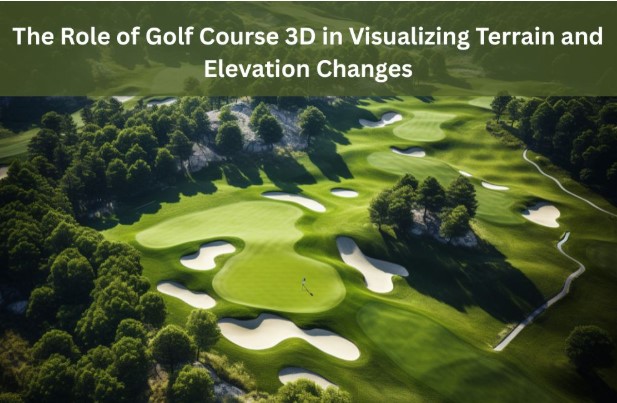

Golf course designs tend to be very dependent on the land topology on which the design is created. Land topology, elevation variations, slopes of the land, and land topology transitions are always very important in the playability, drainage facilitation, constructibility, and maintainability of the land designed for a golf course.
However, these aspects are very difficult to interpret when relying solely on the two-dimensional graphics of the land and the depiction of the land topology using the said graphics. This has made the use of golf course 3D a very important aspect of modern designs for a golf course.
With the capacity to express topographical information through realistic three-dimensional images, this helps developers and designers form a much clearer conception of the topographical relationship between the land and how each aspect of topography affects the other. This is especially useful with the models for subtle changes that might have been overlooked.
Terrain Complexity Perception through Depth Cues
Golfing ground site location could entail undulating land, irregular slopes, and natural landforms that could influence a golfing ground site layout. When a 2D image is involved, an interpretation problem concerning contour lines could pose a problem to a layman. Golf course 3D removes this problem by showing the land as it is.
The design team can now see the shape of the fairways as well as the lay of the land on which the greens sit. This allows the design team to make more informed decisions right at the beginning of the design process.
Correct Depictions of Elevation Variations
Even the smallest differences in the grade of holes can have a huge effect on the difficulty of playing the course, as well as the cost of building. Even the smallest slope could affect the drainage system, the mowing difficulties, as well as the difficulty of playing a hole. The design of the old course does not represent the real effect of the differences.
A 3D golf course model makes it easier for the height of the land to be translated into useful landforms, and this makes the gradient and differences in land height visible. The models may aid in ascertaining whether the land is steep, the points for changing grades, and whether the differences in land height are an advantage to the land or a disadvantage.
Improvement of Drainage and Water Management Practices
The water flow is directly influenced by the topography or elevation of the underlying land. Where the land topography is not known, drainage issues, damage to turf, or high costs of maintenance can easily be experienced. Topography knowledge is imperative in drainage system designs.
Thanks to three-dimensional imaging, it will be possible to accurately forecast future water flow on the golf course after rain events. The areas for water accumulation and paths for drainage of this water will be traced easily. This will help experts in planning and designing more intelligent drainage systems for golf courses to preserve the grass.
Facilitating Informed Decisions on Designing the Strategic Course
Golf as a game requires strategy, and the terrain is one of the elements that would impact the playing of the hole. Uphill shots, downhill shots, elevated greens, and sloping surfaces are some of these.
The Golf Course 3D modeling is a useful tool for golf course designers to evaluate the strategic elements of a golf course graphically. The golf course designer can change the position of holes in different observation angles of the land, thus allowing the designer to create aesthetically harmonious holes with their environment and offer interesting golfing experiences.
Enhancing Communication with Stakeholders
Generally, a golf course project needs the cooperation of architects, developers, environmental experts, and investors. Their individual definitions of the technical plans may differ.
Since everyone has access to the information, the following benefits are realized by the use of the three-dimensional representation of the terrain: it becomes very easy to discuss and obtain approvals because the change, which will be in the form of landforms, will be visible.
Minimizing Construction Risks and Unexpected Expenses
Some of the challenges that might be experienced when involved in a construction project may be those that might happen if the topography is not well known or factored in.
Using 3D golf courses allows one to determine possible construction issues that might be encountered on the golf course, even before digging has started. This resolves any issues with costly change orders and keeps all construction within the stipulated time.
Promoting Environmental and Sustainability Objectives
Modernly conceptualized golf course development places major emphasis on both sustainability and environmental considerations. Natural land formation retention, minimizing earth-moving, or protecting sensitive areas are some factors that are influenced by knowing topographical details.
Three-dimensional modeling in golf courses allows the design of golf courses in conjunction with nature rather than designing contrary to it. With the knowledge of topographic data, designs can prevent pointless grading for golf courses in harmony with nature.
Boosting Confidence in Clients as Well as Investors
Clients and/or investors would not be able to see what the eventual project looks like using the technical description alone. The real terrain representation gives confidence in the eventual projects having the elevation differences of the real terrain.
The fact is, it is easier for stakeholders to understand design and potential on a parcel of land when they see it all come together in three dimensions.
Long-Term Value Beyond Initial Design
The benefits of proper terrain visualization are not only applicable to the design and implementation phase. The three-dimensional map of the terrain can also aid in future renovation and upgrade projects of the course.
Even after the life span of the golf course has started, the data about the differences in the level of the land is still important; hence, the application of 3D visualization is of immense value.
Concluding Observations
The accurate representation of land as well as its elevation is among the most important factors that play a significant role in ensuring that golf course construction projects are a success. The role that Golf Course 3D currently plays is indeed important, as it assists in land dynamics as well as drainage, among other factors. When integrated with advanced 3D models of golf courses, the project team can effectively analyze the terrain and make appropriate decisions.
The ever-increasing demands on accuracy, sensitivity to the environment, and efficiency have made 3D terrain visualization a critical part of the design and planning of a golf course.